Hidden losses found
Failures traced across siloed ERP, warehouse and manual data, back to the cause.
$270M in hidden annual losses found
$30M ready to recover
$30M ready to recover
Your OTIF rate is below target, or it swings from week to week. The weekly report says it slipped. It does not say which part of the chain to fix.
Orders, shipments and stock sit in different systems, and the manual workarounds sit outside all of them. By the time a failure is visible in a dashboard, the truck has already left.
Most reporting attributes a miss to the last step that touched it. The cause is usually further upstream, in a supplier, a route or a plant that has been drifting for weeks.
Every supplier, route, site and order is held with what depends on it, built from the systems you already run.
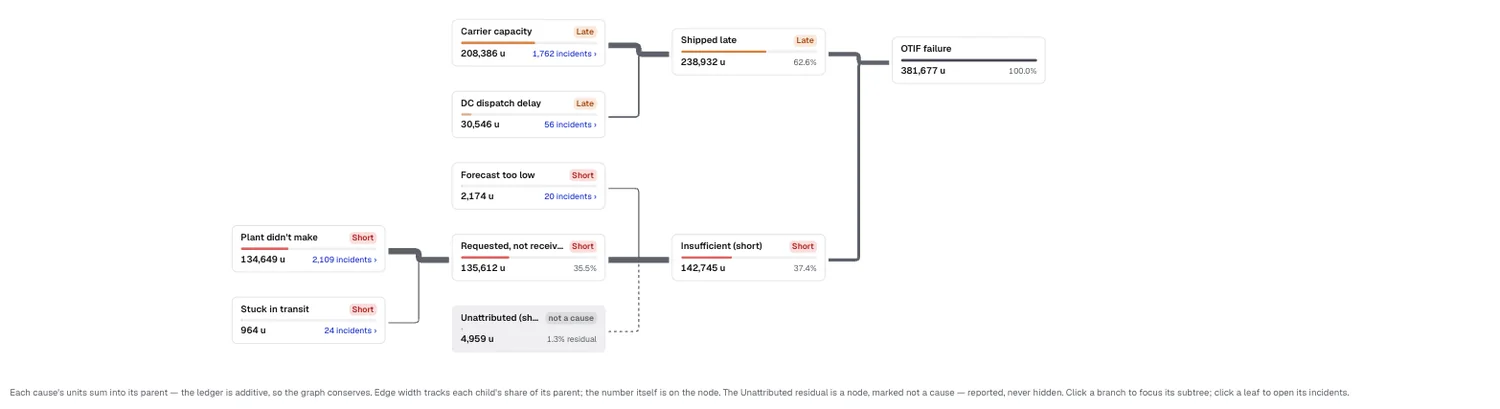
A missed delivery is split into the carrier, dispatch and production shortfalls behind it, each with its share and its evidence.
Each candidate fix is simulated forward against the same picture, so you can see what it recovers before you commit.
From delivered projects with enterprise customers.
Failures traced across siloed ERP, warehouse and manual data, back to the cause.
Bring a decision. We'll discuss how to model it and what data a simulation would need.
Talk To An Expert